Issue #75

View this email online


Curiously Green


The steps to take for a fossil fuel free internet
 

Welcome to the May issue of Curiously Green.

There has been a lot of news in the Humane Web space this month which means Issue #75 is a bumper one.

Amidst all the issues, two things dominated my attention this month. Firstly the Green Web Foundations “State of the Fossil-Free Internet 2026” report which is a hugely impressive and important piece of work. Secondly the cancellation of a digital human rights conference, Rights Con is probably the most important bit of digital news you haven’t seen this month.

Elsewhere I’ll be sharing news of an update to our Digital Declutter toolkit, as well as the best content from the last month about the open web, digital ethics and sustainability. I’ve also got a very positive update on what CarbonRunner’s founder, Dryden Williams is doing next. It’s not what you might expect…

Get comfy, have a read and let me know what you think of the issues in this, err, issue!

Andy Davies

Curiously Green Manager – Wholegrain Digital


The big three this month
 
The campaign for a fossil free internet
 

The campaign for a fossil free internet


When it comes to the Humane Web, I tend to see two distinct groups of news and articles. On the industry side, there are flashy announcements about new features. Take Google’s recent UI update, announced at their I/O conference. Lists of links are out and a LLM style experience is in. TechCrunch had an early, hyperbolic take “Google search as you know it is over” , while Time magazine “Google Shifts to AI Search, Heralding Major Change in How People Use the Internet” was slightly less breathless.

The Time article talks a little about the potential impacts on the internet that Google relies upon for its output, but doesn’t dwell on the matter. Web engineer Matthias Ott does dwell on this, in his piece “Ad Infinitum” though. Whatever happens it’s unlikely that it will be the last you hear about the changes to Google in Curiously Green.

The second group of articles that end up in my bookmarks folder cover the environmental and social impacts of tech. None of the articles I’ve read about Google’s UI changes mention this though, which is curious because there is more and more evidence that an increased amount of AI features means that digital emissions will go up (and up and up).

In April the UK government quietly announced that UK carbon emissions from data centers might be 100 times higher than previously forecast. Previous estimates put the forecast emissions from AI at 142,000 tons CO2e but that has now been revised to 123 million tons CO2e. Shedding some light into this upward shift, is the revelation that many of the UK’s new data centers plan to burn gas to power themselves. The requests for gas generation for data centers equate to 15 terawatt hours, which is equivalent to London’s energy requirements for around 4.5 months.

To put it simply, if the world is going to use more AI, for search, for business, for government, for daft smart glasses, that increase is going to be powered by fossil fuels.

The evidence of this is all around us, none more so than in Anthropic’s recent deal with Space X to use their Colossus data centre to increase their capacity. Anthropic’s lofty goals – “At Anthropic, we build AI to serve humanity’s long-term well-being” seem at odds with the decision to use a data center that is subject to legal challenges of its unpermitted usage of highly polluting gas turbines.

Fighting back

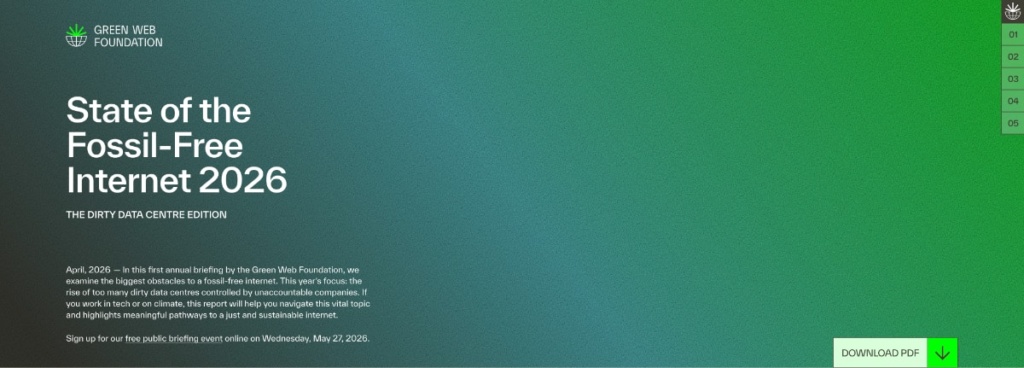
The Green Web Foundation is pushing hard to bring these increasing digital emissions into sharp focus. As part of their ambitious plan to push for a fossil fuel free internet by 2030 they are looking at the biggest obstacles in the way of this goal. In their first annual briefing they single out data centers. In their view there are “too many dirty data centres controlled by unaccountable companies”.

The site that presents the report is a masterclass in sustainable web design. Low weight data visualisation, clean coding, clear hierarchy and accessible legibility, the site itself is worth visiting just for that.

But the message is the most important thing. With a clear-eyed fury, the report takes aim at companies like Amazon, Google, Microsoft and others who are choosing growth, speed and recklessness over a more considered, safer roll out of their technologies.

Most importantly it provides clear pathways that work towards their goals.

  •  Reduce the energy demand – The internet must operate within planetary boundaries
  •  Green the energy – We’re calling on the digital sector to cut ties with fossil fuels
  •  Democratise tech – We need more alternative ownership models to rise to challenge corrosive power (of big tech companies)

Each of these pathways has three actions to support the next steps. These actions are things that anyone can engage with and get involved in.

If you read one thing in this newsletter from start to finish, it should be this report.

You can attend a free public briefing on the report this afternoon, the 27th May 2026. Sign up here.

 
Geo-Politics kills Rights Con 2026
 

Geo-Politics kills Rights Con 2026


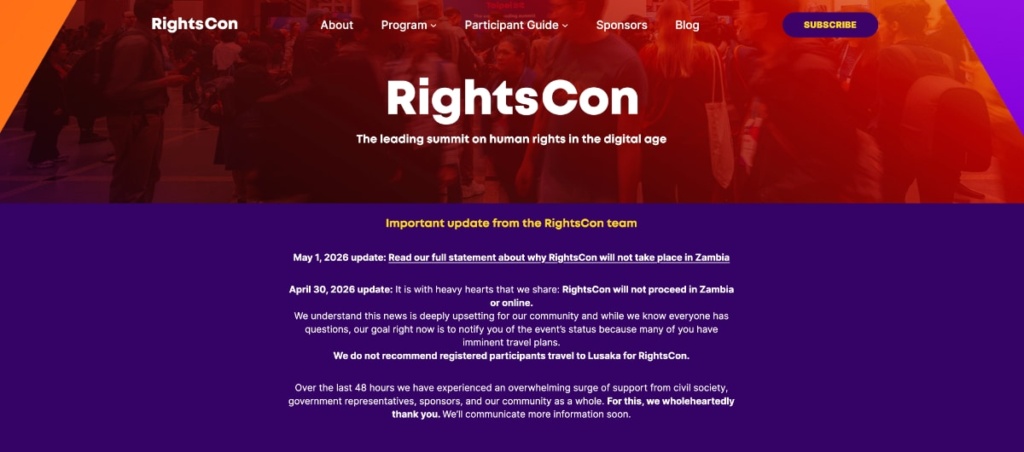
Probably the most important but under reported story in the last month concerns the cancellation of Rights Con. I’m slightly embarrassed to say that I didn’t know about the conference until it was cancelled and I’m sure I’m not alone in this.

Rights Con is the leading summit focusing on human rights in the digital space. For 14 years the organisers have been holding summits which bring together “business leaders, policymakers, general counsels, government representatives, technologists, academics, journalists, and human rights advocates from around the world to tackle pressing issues at the intersection of human rights and technology”.

This year the summit was due to be held in Zambia in early May. After African speakers and delegates had experienced difficulties obtaining visas to visit previous summits, so the organisers committed to taking the event back to Africa. The aim was to highlight the global significance of Africa’s digital rights community and their global influence. Work to stage the event in Zambia began in 2024 and the team has had close working ties with the Zambian authorities from the start.

With only days to go before the summit kicked off, things started to go awry. The evidence points to political interference from China, who it appears were unhappy that Taiwanese activists were due to speak at the event. Zambia has an abundance of minerals and natural resources that are vital for de-carbonisation. China has multiple interests in this area.

While China has rightly been applauded for its progress in renewable energy technology, grid improvements and innovation in the EV sector, this is a reminder that things are rarely so clear cut. Social and climate justice play vital roles in combatting the climate crisis too.

While human rights and freedom of speech can be stifled in the name of climate aligned political and economic interests, it’s clear that we need Rights Con now more than ever.

Further information:

 
The Digital Declutter Toolkit gets a revamp
 

The Digital Declutter Toolkit gets a revamp


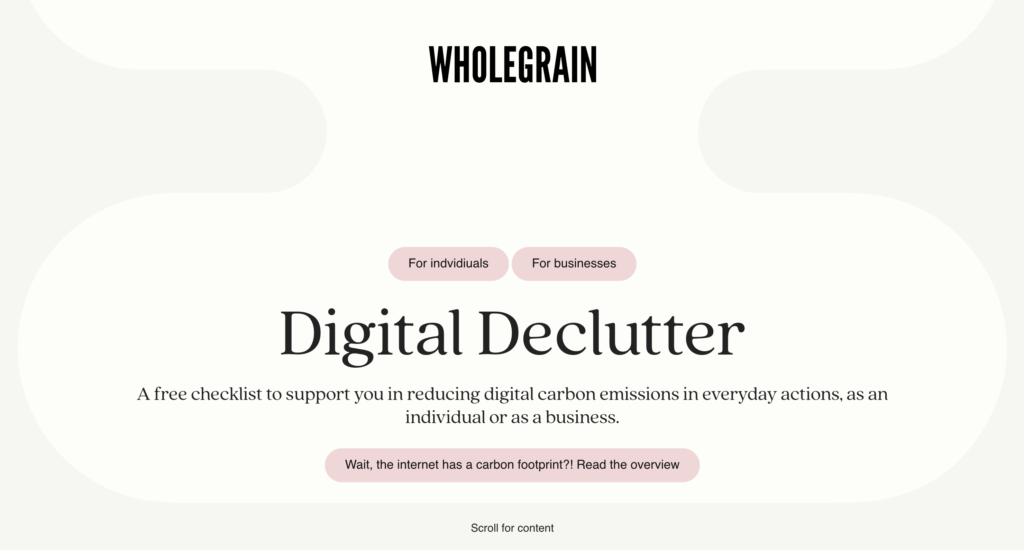
Rounding off this section is news that in collaboration with Ecosend, Business Declares and Earth Minutes, Wholegrain have redesigned and updated the Digital Declutter toolkit.

The original toolkit was a labour of love for my predecessors in the Curiously Green hot seat, Tom and Marketa. Conceived as a “a free checklist to support you in reducing digital carbon emissions in everyday actions, as an individual or as a business” the toolkit has been providing actionable advice and insights since 2021.

The latest iteration takes those amazing foundations and builds upon them with updated advice, statistics and user interface designed by our in-house specialist Chânelle.

Have a nosy around and choose (at least!) one positive action from the checklist to carry out this month.


Other interesting Humane Web links, articles & reports

 from the past month


Curiously Green is curated by Andy Davies with input from the Wholegrain team and the Curiously Green community


Declutter your Digital – use this **UPDATED** toolkit to help you measure and reduce your digital emissions


Test your web pages with Website Carbon