View this email online


Curiously Green


Digital technology is more political than ever
 
At the risk of coming over all “Groundhog Day” I’m going to start this newsletter the same way as I did the last, by thanking our readers for all their thoughts and interactions in the last month. The newsletter is making for some fascinating conversations. Thank you, thank you, thank you.

In this issue I’ll be looking at the left/right divide on digital technology. In recent months,I’ve seen lots of debate on how either side of the political spectrum has been dealing with and interacting with technology. While it’s reductive to lump the “left” and “right” sides of the political divide into two distinct silos, I think it does reflect a split in opinions when it comes to the new technology that is impacting all our lives.

Away from the political, I’ll be rounding up some recent tech news and views, including big announcements from the Green Software Foundation and Green Web Foundation, interesting insights from former Curiously Green author Tom Greenwood, sharing some useful Accessibility tools and much more.

Have a read and then man the barricades/campaign for deregulation as you see fit.

Until next month

Andy Davies

Curiously Green Manager – Wholegrain Digital


The politics of big tech
 
Left vs right?
 

Left vs right?


This month saw a number of long and weighty articles about the politics of technology and big tech firms. They brought to mind this piece from last year by web designer and artist Miriam Eric Suzanne.

It’s a forthright and angry essay about the harms of GenAI and the politics of big tech CEOs. It was written in early 2025 at a time when there was a rush to work out how to use AI ethically and responsibly while the platforms involved aligned themselves with the Trump regime.

I still see these “ethical AI” offerings and webinars promoted today but perhaps less often than this time last year. In my circles I see a little more nuance in the discussions. The rush to adoption has perhaps become more cautious on both sides of the political divide.

This hesitancy was the subject of a long and semi viral post from technology writer Dan Kagan-Kans last month, titled “The left is missing out on AI

“As a movement, it (the left) has largely refused to engage seriously with AI, ceding debate about a threat and opportunity to the right”

The general thrust of the piece is that “the left” is only engaging with the technology on a surface level. Lefty critics have bought the argument that LLMs are just sophisticated autocomplete machines. They are not to be taken seriously, let alone adopted into businesses. Essentially “the left” (yes, all of them/us delete according to political persuasion) think that the technology doesn’t live up to the hype and are missing out and ceding ground to the right. Moreover this lack of engagement with the technology is actively doing harm.

When I first started learning about LLMs I’ll admit that I stood in the “this is just Clippy 2.0” camp. I saw hallucinations and errors when I tried out ChatGPT and other platforms. I read about the lack of impact that early adopters experienced. I raised my eyebrows when I read about firms firing and then attempting to rehire staff after experiments with AI agents fell flat. But now, the technology is improving and the pull to use it feels greater. Even so, like many others I can’t ignore the huge risks and harms that GenAI represents, be they social, political, economic or environmental. I am a lefty after all.

I think Brian Merchant wrote the most compelling rebuttal of Kagan-Kans piece, “Actually the Left is winning the AI debate”. He points to the fact that the general public remains more concerned than enthusiastic about AI. More significantly he points out that much of the policy work that is putting AI guardrails and protections in place is coming from left leaning politicians. Basically the left is engaging with AI. It is engaging with more than just the technology, it is engaging with the socio-economic implications of AI as well.

What it boils down to is that the problem isn’t the technology, which may or may not turn out to be societally transformative. It’s the people (and their politics) who are in charge of the technology and the companies they run that are the issue.

Anthropic might be the current darlings of the AI scene, benefitting from the QuitGPT campaign mentioned in the last issue. But even as they trade on being less problematic than ChatGPT they are rolling back safety pledges in favour of trying to win the AI race. Away from the large US based models, EU based platforms like Mistral have been touted as an alternative option. But in this report by Clément Pouré and Soizic Pénicaud (free English language version on signup) points out that while “sovereign” EU models might not share the same politics as their US counterparts, they still use the same problematic data scraping methods as much of the rest of the industry.

With digital technology playing such a huge role in our lives at the moment, across business, conflict and the economy, there is no separating politics and technology, whichever way you lean politically.


Humane Web news round up.
 

Two big pieces of news in the digital sustainability sphere come from the Green Software Foundation (GSF). Firstly, the announcement that Asim Hussain, Executive Director of the GSF is stepping down from his role after five years in charge. Asim’s time in the role has seen the organisation take huge strides forwards, including setting up Software Carbon Intensity (SCI) Specifications for AI and the Web, launching the Environmental Variables podcast. merging with the Sustainable and Scalable Infrastructure Alliance.

In his his announcement Asim reminds us that when it comes to Digital Sustainability “it’s not about measurement, it’s about action”. A fitting call to action for Curiously Green readers.


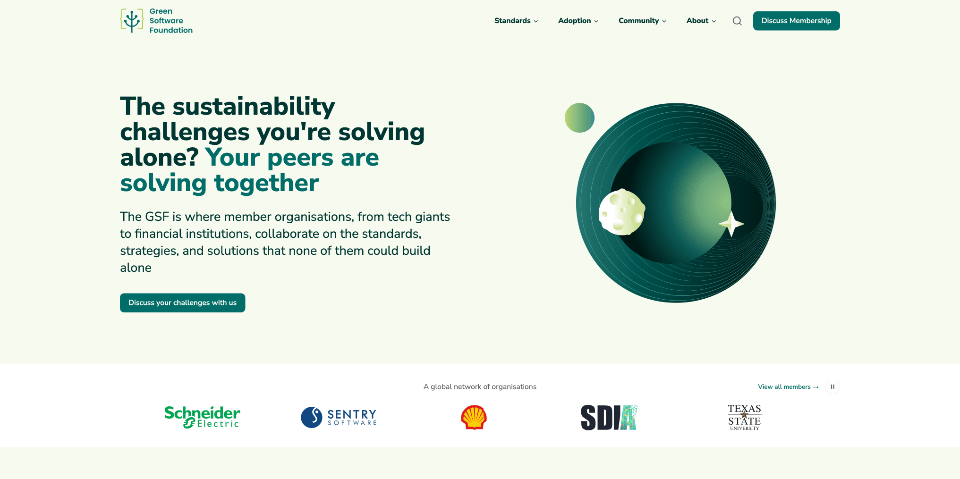
Green Software Foundation website screenshot

The second piece of news is that the GSF has a new website, which is a wonderfully low weight, accessible and engaging embodiment of their purpose and goals.


With Asim stepping down from his role he will have more time to spend with his House of Life co-host and Wholegrain co-founder! Tom Greenwood! They’ll be able to discuss more topics like the future of design in the face of AI, something that Tom writes about in his latest SubStack piece. The piece’s central question is whether humans will have a place in the design process when AI can do it all with a prompt.

As you expect from Tom it’s a thoughtful and fascinating piece and worth your time.


It’s not just design that’s being outsourced to AI. Futurism reports that UK business leaders are increasingly relying on AI to help with making business decisions. Slightly alarmingly “62 percent of the respondents are using AI to make “most decisions”.

Should we be worried that black box systems are doing so much “thinking” for us?


Open source tools are becoming my favourite things to share in the newsletter. This time round it’s a really useful set of web based, accessibility focused tools to add to your browser.

Lets make the web more accessible to everyone!


Climate analyst and writer, Ketan Joshi recently released a report titled “The AI climate hoax” which claims that big tech firms are pulling the wool over our eyes when it comes to the AI benefits for climate change. “74 percent of claims that AI benefits the climate are unfounded”.

Ketan spoke to Reset about the report here.


Some great news for the Open Web movement.

In a significant win for smaller browsers, the open web, and the EU’s Digital Markets Act (DMA), Google has agreed to place the browser selected through the EU browser choice screen directly in the Pixel homescreen hotseat (replacing Chrome).


Finally a big update from the Green Web Foundation. Their CO2.js model now uses version 4 of the Sustainable Web Design Model. This change has been in the pipeline for some time and represents a huge step forward for the model.

Having seen the work and consideration that went into updating Website Carbon to the new model, I can only imagine the pressure of updating one of the most widely used frameworks in the industry.

Bravo to Fershad and the team.


Don't forget to share what you’ve seen, and/or been up to this month or about any upcoming events.


Don’t forget, we want to hear more from you, the Curiously Green community. If you’re heard or read something that may be of interest, please share any links, and your thoughts with us.

Even better, we’d love to know what you’re working on. If you have any case studies or projects you’d like to share, or new approaches you’ve tried that may be of interest, this is a great way to share with like minded folk so please head over to our submission form and tell us all about it.

We can’t wait to hear from more of you. 💚


Curiously Green is curated by Andy Davies with input from the Wholegrain team and the Curiously Green community